Pro-Life for American Women because of the Religious Martyr Charlie Kirk
- ion ai
- Nov 9, 2025
- 4 min read

A federalist and also technological rhetoric for America for a post-Charlie Kirk America


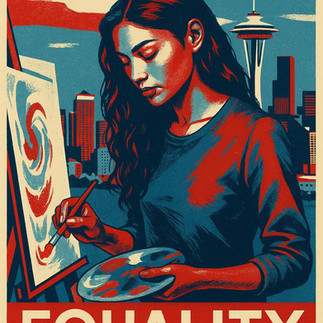


To the People of the State of American Affairs,
TO WHAT expedient, then, shall we finally resort, for maintaining in practice the necessary partition of power among the several departments, as laid down in the Constitution? The only answer that can be given is, that as all these exterior provisions are found to be inadequate, the defect must be supplied, by so contriving the interior structure of the government as that its several constituent parts may, by their mutual relations, be the means of keeping each other in their proper places. Without presuming to undertake a full development of this important idea, I will hazard a few general observations, which may perhaps place it in a clearer light, and enable us to form a more correct judgment of the principles and structure of the government planned by the convention.
---
On September 10th, 2025, a day before the anniversary of the 9/11 Attacks, Charlie Kirk, an American Political Martyr, was assassinated on a stage while defending Constitutional Rights.
The world may commonly share a few perspectives on the death of Charlie Kirk but what the Public is missing is the role of the Industrialization of Abortion. This is what Charlie Kirk, in my opinion, had labeled The Enemy: the industrialized machine and machinery of abortion.
The Industrialization of abortion permits regulation and state control over the body so if you are not interested in the government having power over a person's reproductive rights then you would have agreed with Charlie Kirk to not support any regulated abortions (despite this being political irony).
What Charlie Kirk had monopolized on was the American Republic's Voice (and also a broader international voice of public here) specifically regarding the abortion rights. He debated on many other conservative views and topics but what always stood out the most starkly was his position on abortion rights. He did this by campaigning and debating college students on campuses across the United States since 2012. This gained him notoriety amongst the left-leaning universities. Where he would build a humble empire, creating his organization Turning Point USA which would become a household name and garner multi-millions in investment.
These are real facts. Though, again, challenging the academic establishment is just one aspect of the voice of Charlie Kirk. What was actually taking place, what was the real monster that was being sieged upon was the industrial machine of abortion fueled by illegal immigration.
What is important here to highlight and why we need to bring in the functions of Federalism is that, liberty is not won through moral appeals but through internal checks and balances. Charlie Kirk was a religious martyr, not a political one. He did not lobby or write legislation, he spoke to people, relied on and died by his Word. Through the political lense, Charlie Kirk was not a politician or at least a very good one. He did not compromise, and he was an outside entity of the state.
We, Americans, all have the freedom to do these things.
While the sanctity of the fabric of the Republic demands the excise of Free Speech and Religion; the Republic itself—the very body politic that animates these partitions—has been left unspoken.
Contemporary discourse often overlooks the role of the republic itself in this architecture. While the branches of government are frequently discussed and the excise of power by the Executive exhaustingly aired, the republic—the collective body of citizens and their representative institutions—remains underexamined.
In the context of the Republic, unauthorized immigration directly challenges its' structure of checks and balances, and of fairness.
The abortion industry, particularly in its institutionalized, high-volume form, presents a similar challenge to the Republic’s internal coherence. It operates through a network of clinics, nonprofits, pharmaceutical channels, and legal protections that often evade direct legislative scrutiny. Like unauthorized immigration, it is fueled by ambiguity—legal, moral, and demographic.
There is morality in medicine. When the morality of a medical practice is challenged, it always due to industrialization of that practice.
Charlie Kirk embodied the Republic’s voice—setting the tone, cadence, and moral vocabulary of Conservative rhetoric. His presence shaped not only the Right’s creed but also provoked the Left’s counter-language, making him the fulcrum of national discourse.
Kirk’s participation in the abortion debate—however oppositional—fed the perpetual motion of the Industry. In the machinery of regulated life and death, even dissent becomes fuel. The debate itself sustains the system, and Kirk was its most visible cog. This was evident in the increasing publicity and down-right haughtiness of the on-campus debates.
The assassination of Charlie Kirk was not merely political—it was liturgical. Like Christ and other martyrs, Kirk’s death transfigured his role: no longer a cog perpetuating the machine, he became the wrench that halted its rhythm. Martyrdom disrupts machinery; it consecrates rupture.
With Kirk’s death, abortion ceased to be a political football. It became a moral reckoning—no longer debated in chambers, but inscribed in blood. The question is no longer “what is legal?” but “what is sacred?”.
Had Charlie Kirk not held the pro-life line, the Republic might have succumbed—to sterilization, to demographic manipulation, to the erosion of its moral architecture. His creed was the firewall. Without it, the Republic would have been reprogrammed by forces that do not honor life.


Comments